New law expected to improve lawmaking process

The 2025 Law on Promulgation of Legal Documents, with 72 articles arranged in nine chapters, removes the competence of commune-level administrations to promulgate legal documents so as to meet the requirements on renewal and improvement of the lawmaking process.

Set to take effect on April 1, the 2025 Law on Promulgation of Legal Documents (the Law), with 72 articles arranged in nine chapters, removes the competence of commune-level administrations to promulgate legal documents so as to meet the requirements on renewal and improvement of the lawmaking process.

As per Article 4 of the Law, resolutions of commune-level People’s Councils and decisions of commune-level People’s Committees will be removed from the legal document system, thereby decreasing the number of types of legal documents to 14 only.
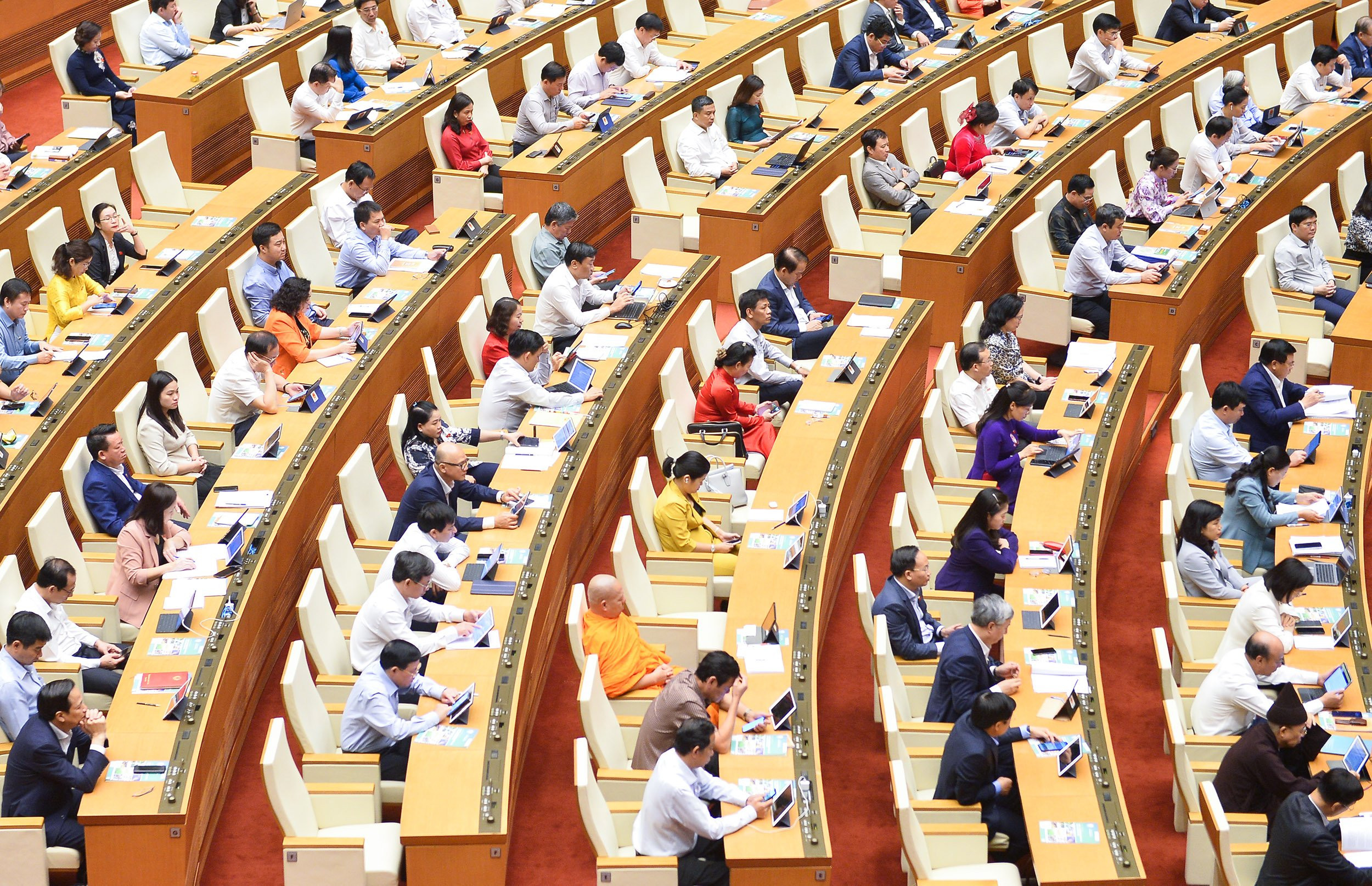
New law expected to improve lawmaking process

Meanwhile, the Law adds one more type of legal document, i.e., resolution, which will be issued by the Government. Hence, the Government will promulgate decrees and resolutions. According to the drafter, the Ministry of Justice, it is necessary to increase the Government’s competence for promulgation of resolutions (in addition to decrees) with fast-track procedures to promptly settle arising problems.

Noticeably, legislative programs will replace the current law- and ordinance-making programs.

Article 24 of the Law says that, based on the National Assembly's tenure-based legislative orientations or the requirement for settlement of arising problems, the National Assembly Standing Committee will propose the formulation of the National Assembly’s laws and resolutions, and the National Assembly Standing Committee’s ordinances and resolutions.

For their part, the President, the Ethnic Council, the National Assembly’s Committees, the Government, the Supreme People's Court, and the Supreme People's Procuracy will send proposals on the formulation of laws and resolutions of the National Assembly, and ordinances and resolutions of the National Assembly Standing Committee to the National Assembly Standing Committee before August 1 every year for inclusion in the legislative program for the following year.

Based on such proposals, the National Assembly Standing Committee will decide before October 1 every year on the legislative program for the following year.- (VLLF)

1900 6192 để được giải đáp qua tổng đài
090 222 9061 để sử dụng dịch vụ Luật sư tư vấn (CÓ PHÍ)
Đánh giá bài viết:
Bài viết đã giải quyết được vấn đề của bạn chưa?
Rồi Chưa

Tin cùng chuyên mục

Vietnam Law Day promotes respect for legislation and culture of legal compliance

Vietnam Law Day promotes respect for legislation and culture of legal compliance

Vietnam Law Day promotes respect for legislation and culture of legal compliance

Observed annually on November 9, Vietnam Law Day seeks to promote respect for the constitution and the law, raise public awareness of legal compliance and encourage people to make respect for regulations an integral part of everyday life. This year’s activities place greater emphasis on practical, people-centred legal education and digital transformation.

Proposed programme strives for at least 50 per cent drug-free communes and wards nationwide by 2030

Proposed programme strives for at least 50 per cent drug-free communes and wards nationwide by 2030

Proposed programme strives for at least 50 per cent drug-free communes and wards nationwide by 2030

The Government has recently proposed a national target programme on drug and crime prevention and control for the 2026-35 period, that aims for at least 50 per cent of communes and wards nationwide to be drug-free by 2030, binding the responsibilities of grassroots Party Committees and local authorities.

Vietnam well-positioned to attract high-quality European investment: insiders

Vietnam well-positioned to attract high-quality European investment: insiders

Vietnam well-positioned to attract high-quality European investment: insiders

Vietnam has established a considerable manufacturing and export base, giving it an advantage in attracting investment from European corporations. However, amid the restructuring of global supply chains, the key objective is not merely to attract more investment, but also to enhance the quality of investment and the value it generates.