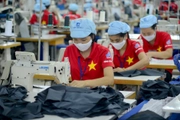
Many workers may still wonder whether they are required to participate in unemployment insurance when they already have a job and what the participation is for. Below are the subjects required to participate in unemployment insurance.
Subjects participating in unemployment insurance
According to Article 31 of the Law on Employment 2025, from January 1, 2026, there will be 02 groups of subjects required to participate in unemployment insurance, including:
(1) Workers:
Persons working under indefinite-term labor contracts, definite-term labor contracts with a term of full 01 month or more, also including cases where the workers and employers agree on a document with a different name which contains the contents showing paid work, salary and management, operation and supervision by one party.
Workers specified at Point a of this Clause who work part-time and have monthly salary equal to or higher than the lowest salary on which compulsory social insurance premiums are based in accordance with Law on Social Insurance;
Persons working under working contracts;
Salaried managers of enterprises, controllers, representatives of enterprise capital as prescribed by law regulations; salaried members of the Board of Directors, General Directors, Directors, members of the Board of Supervisors or controllers and other elected management positions of cooperatives and unions of cooperatives as prescribed by the Law on Cooperatives.
If a worker simultaneously falls into different categories of unemployment insurance participants as specified in this Clause, the worker and the employer shall be responsible for participating in unemployment insurance along with compulsory social insurance.
Exception: Workers as specified in Clause 1 of this Article who are currently entitled to salaries, social insurance allowances and monthly allowances according to the Government’s regulations, or who are eligible to enjoy a pension; workers on probation contracts as defined by labor law; and domestic workers are not subject to participation in unemployment insurance.
(2) Employers:
Employers participating in unemployment insurance include:
State agencies, public non-business units;
Agencies, units and enterprises of the People’s Army and the People’s Public Security forces and cipher organizations;
Political organizations, socio-political organizations, socio-politico-professional organizations, socio-professional organizations and other social organizations;
Foreign agencies and organizations, and international organizations operating in Vietnam’s territory;
Enterprises, cooperative groups, cooperatives, unions of cooperatives, business households, other organizations, and individuals that hire or employ employees as defined in Clause 1 of this Article.
Period of payment of unemployment insurance premiums
According to Article 35 of the Law on Employment 2025, the period of payment of unemployment insurance premiums for receipt of unemployment insurance benefits is the total of periods of payment of unemployment insurance premiums from the starting time of such payment to the time the worker terminates his/her labor contract or working contract or terminates his/her work under law but during which he/she has not yet received any unemployment allowance.
If a worker stops receiving unemployment allowance, his/her subsequent period of payment of unemployment insurance premiums will be counted from the beginning.
Individuals engaged in affiliate marketing who earn income from commissions, advertising and other sources must fulfill their tax liabilities in accordance with regulations. How much tax must these individuals pay?
Vietnamese workers working for foreign organizations and individuals in Vietnam need to know which agencies or organizations they may request support from when their rights and interests are affected, as well as what they must do after entering into a labor contract.
Decree No. 371/2026/ND-CP detailing the recruitment and management of Vietnamese workers working for foreign organizations and individuals in Vietnam, effective from November 15, 2026, introduces several changes concerning the reporting responsibilities of the parties involved in recruitment.
The resolution on national security strategy provides a broader approach to protecting national security for a period in which technological advance, economic interdependence and non-traditional security risks are increasingly interconnected.
How does Circular No. 118/2026/TT-BTC regulate the application of International Accounting Standards in Vietnam? Which enterprises may choose to apply these Standards, and what principles must they follow?
The Urban Development Law is expected to unlock resources and enable Vietnamese cities to develop on the basis of productivity, technology and regional connectivity and become new growth poles of the economy.
A number of new Decrees officially take effect from October 1, 2026, directly affecting various areas. Below is a list of Decrees taking effect in October 2026.
A roundup of key new policies and regulations taking effect in October 2026, covering banking, social policies, taxation, investment, and other areas of interest to individuals and businesses.
The 2026 amended Law on Vietnamese Guest Workers has amended and supplemented various regulations on worker source preparation, training fees, recruitment, contracts, licenses, and responsibilities of enterprises providing the service of sending Vietnamese workers abroad as guest workers.
Circular No. 48/2026/TT-BCT introduces a number of new regulations on procedures for importing goods under tariff quotas, covering dossiers, procedures, and the confirmation of tariff quotas for traders.

 English
 RSS
RSS