
 English
 RSS
RSS
Acts of making incorrect declarations to reduce payable tax amounts
Clause 1, Article 142, Law on Tax administration 2019 prescribes that the acts of making incorrect declarations to reduce payable tax amounts or increase exemptible, reducible, refundable, or uncollectible tax amounts include:
(1) Incorrectly declaring tax bases or deductible tax amounts or wrongfully identifying cases eligible for tax exemption, reduction, or refund leading to a decrease in payable tax amounts or an increase in exemptible, reducible or refundable tax amounts while economic operations have been fully reflected in account books, and lawful invoices and documents;
(2) Providing in their market price determination dossiers or transfer pricing transaction declarations figures different from the figures found through inspection or examination in order to reduce payable tax amounts or increase exemptible, reducible or refundable tax amounts, as concluded by tax administration offices or other competent agencies;
(3) Using unlawful invoices or documents, or illegally using invoices to account for the value of purchased goods or services in order to reduce payable tax amounts or increase exemptible, reducible or refundable tax amounts in case goods or service purchasers can prove that sellers are at fault regarding the use of such invoices or documents.
Note:
- Taxpayers that make incorrect declarations to reduce payable tax amounts or increase exemptible, reducible, refundable or uncollectible tax amounts for imported or exported goods but do not fall into the cases specified in Clauses 6 and 7, Article 143 of this Law shall, in addition to making additional declarations and fully paying tax amounts and late-payment interests, be sanctioned for tax administration-related administrative violations in the following cases:
- Taxpayers discover by themselves incorrect declarations and make additional declarations after customs offices notify the direct inspection of customs dossiers for goods currently undergoing customs procedures or within 60 days from the date of customs clearance and before customs offices to decide on post-customs clearance inspection or inspection of customs-cleared goods;
- Customs offices detect incorrect declarations while carrying out customs procedures, inspecting customs-cleared goods or carrying out post-customs clearance inspections and violators are willing to remedy consequences by fully paying payable tax amounts under regulations;
- Taxpayers do not fall into the cases specified at Points a and b of this Clause and are willing to remediate consequences by fully paying payable tax amounts.
- Taxpayers that make incorrect declarations to reduce payable tax amounts or increase exemptible, reducible or refundable tax amounts but then make additional declarations in tax declaration dossiers and are willing to remediate consequences by fully paying payable tax amounts before tax offices announce tax examination or tax inspection decisions at the taxpayers’ offices or before tax offices detect incorrect declarations not through examination or inspection at the taxpayers’ offices, or before competent agencies detect incorrect declarations will not be sanctioned for tax administration-related administrative violations
- For imported or exported goods, taxpayers will not be sanctioned for tax administration-related administrative violations but shall still pay unpaid tax amounts and late-payment interests to the state budget in the following cases:
- They make additional declarations before customs offices notify the direct examination of customs dossiers for goods currently undergoing customs procedures;
- They make additional declarations within 60 days from the date of customs clearance and before customs offices decide on post-customs clearance inspection or inspection of customs-cleared goods.
Sanctioning of the acts of making incorrect declarations to reduce payable tax amounts
Pursuant to Article 16, Decree No. 125/2020/ND-CP, sanctioning the acts of making the incorrect declaration, leading to sufficiency in the payable tax amount, or an increase in the exemptible, reducible or refundable tax amount as follows:
* Sanctioning forms and levels
A fine equal to 20% of the under-declared payable tax amount or the exemptible, reducible or refundable tax amount that is higher than prescribed shall be imposed for any of the following acts of violation:
(1) Incorrectly declaring tax bases or deductible tax amounts or wrongfully identifying cases eligible for tax exemption, reduction or refund leading to a decrease in payable tax amounts or an increase in exemptible, reducible or refundable tax amounts while economic operations have been fully reflected in account books, and lawful invoices and documents;
(2) Incorrectly declaring tax leading to a decrease in payable tax amounts
or an increase in exemptible, reducible or refundable tax amounts, and the taxpayer has voluntarily made additional declarations and fully paid the deficit tax amount into the state budget before the tax agency stops the tax examination or inspection at then taxpayer’s head office;
(3) Incorrectly declaring tax leading to a decrease in payable tax amounts or an increase in exemptible, reducible or refundable tax amounts, has been determined as a tax evasion by the agency competent to make records on tax inspection and examination or administrative violation records, but the taxpayer commits administrative violations of tax evasion for the first time, and has made additional declarations and fully paid the tax amount to the state budget before the time the competent agency issues the sanctioning decision and the tax agency already made a written record to determine that incorrect declaration leads to insufficiency of tax amount;
(4) Incorrectly declaring tax leading to sufficiency in the payable tax amount, or an increase in the exemptible, reducible or refundable tax amount for a transfer pricing transaction, but the taxpayer has already made a dossier of determining the market price or already made and sent its appendices as prescribed by the law on tax administration for enterprises with transfer pricing transactions;
(5) Using unlawful invoices and documents to account for bought goods and service values in order to reduce the payable tax amount or increase the exemptible, reducible or refundable tax amount, but when such violation is discovered by the tax agency through tax examination or inspection, the buyer proves that the sellers are responsible for the use of unlawful invoices and documents, and the accounting has been sufficiently done by the buyer.
* Remedial measures:
The following remedial measures shall be applied besides the fines:
(1) Forcible full payment of the deficit tax amount and the exemptible, reducible or refundable tax amount that is higher than prescribed into the state budget, for the above acts of violation.
If past the statute of limitations, the taxpayer shall not be sanctioned under Clause 1 of this Article, but he/she/it must make full payment of the deficit tax amount, the exemptible, reducible or refundable tax amount that is higher than the prescribed and the late-payment interest into the state budget according to the time limit prescribed in Clause 6, Article 8 of this Decree.
(2) Forcible adjustment of the loss and the deductible input value-added tax amount transferred to the next period (if any), for the acts of violation.
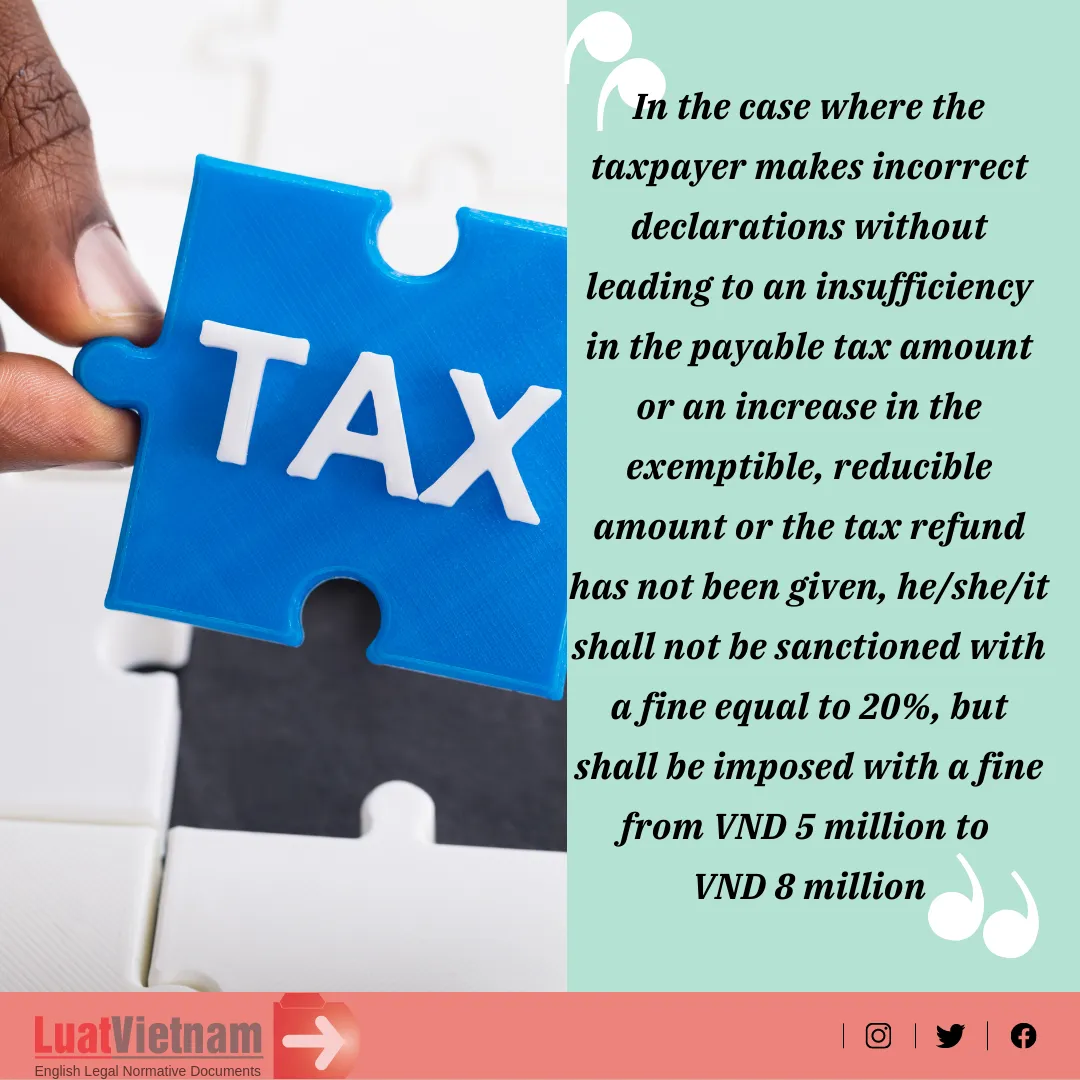
Note: In case where the taxpayer makes incorrect declarations as prescribed at Points a, b and d, Clause 1 of the Decree 125/2020/ND-CP (sections (1), (2), (4) in the remedial measures) without leading to an insufficiency in the payable tax amount or an increase in the exemptible, reducible amount or the tax refund has not been given, he/she/it shall not be sanctioned with a fine equal to 20% under this Article, but shall be imposed with a fine from VND 5,000,000 to VND 8,000,000.
Here are the acts of making incorrect declarations to reduce payable tax amounts or increase exemptible, reducible, refundable or uncollectible tax amounts.