
 English
 RSS
RSS
February 2023 is the formal time for many hot legal policies which have great effects on aspects to take effect. Here are the highlighted policies
 The Ministry of Labor, Invalids and Social Affairs issues Circular No. 01/2023/TT-BLDTBXH specifying coefficients for adjustment of monthly salaries and incomes for which social insurance premiums have been paid (hereafter called slippage coefficient).
Accordingly, the slippage coefficient is applicable from January 01, 2023, as follows:
Table 1: Applied for:
- Employees subject to the State-prescribed salary regime who start paying social insurance premiums from January 1, 2016, onward, have received lump-sum social insurance benefits or die whose relatives are entitled to a lump-sum survivorship allowance.
- Employees who pay social insurance premiums according to the employer-decided salary regime and have received a pension, lump-sum allowance upon retirement or lump-sum social benefits, or die whose relatives are entitled to lump-sum survivorship allowance.
|
Year |
Adjustment coefficient in 2023 |
|
Before 1995 |
5.26 (increased by 0.16) |
|
1995 |
4.46 (increased by 0.13) |
|
1996 |
4.22 (increased by 0.13) |
|
1997 |
4.09 (increased by 0.13) |
|
1998 |
3.8 (increased by 0.12) |
|
1999 |
3.64 (increased by 0.11) |
|
2000 |
3.7 (increased by 0.12) |
|
2001 |
3.71 (increased by 0.12) |
|
2002 |
3.57 (increased by 0.11) |
|
2003 |
3.46 (increased by 0.11) |
|
2004 |
3.21 (increased by 0.1) |
|
2005 |
2.96 (increased by 0.09) |
|
2006 |
2.76 (increased by 0.09) |
|
2007 |
2.55 (increased by 0.08) |
|
2008 |
2.07 (increased by 0.06) |
|
2009 |
1.94 (increased by 0.06) |
|
2010 |
1.77 (increased by 0.05) |
|
2011 |
1.5 (increased by 0.05) |
|
2012 |
1.37 (increased by 0.04) |
|
2013 |
1.28 (increased by 0.05) |
|
2014 |
1.23 (increased by 0.03) |
|
2015 |
1.23 (increased by 0.04) |
|
2016 |
1.19 (increased by 0.03) |
|
2017 |
1.15 (increased by 0.03) |
|
2018 |
1.11 (increased by 0.03) |
|
2019 |
1.08 (increased by 0.03) |
|
2020 |
1.05 (increased by 0.03) |
|
2021 |
1 (No change) |
|
2022 |
1 (No change) |
Table 2: For employees who have paid voluntary social insurance premiums
|
Year |
Adjustment coefficient in 2023 |
|
2008 |
2.07 (increased by 0.06) |
|
2009 |
1.94 (increased by 0.06) |
|
2010 |
1.77 (increased by 0.05) |
|
2011 |
1.5 (increased by 0.05) |
|
2012 |
1.37 (increased by 0.04) |
|
2013 |
1.28 (increased by 0.03) |
|
2014 |
1.23 (increased by 0.03) |
|
2015 |
1.23 (increased by 0.04) |
|
2016 |
1.19 (increased by 0.03) |
|
2017 |
1.15 (increased by 0.03) |
|
2018 |
1.11 (increased by 0.03) |
|
2019 |
1.08 (increased by 0.03) |
|
2020 |
1.05 (increased by 0.03) |
|
2021 |
1.03 (increased by 0.03) |
|
2022 |
1 (No change) |
|
2023 |
1 |
Application time: From January 01, 2023 to December 31, 2023.
Circular No. 01/2023/TT-BLDTBXH takes effect on February 20, 2023 and the provisions of this Circular apply from January 1, 2023.

On December 22, 2022, the Ministry of Finance issues Circular No. 75/2022/TT-BTC prescribing the rates, collection, remittance, and management of fees for residence registration.
Accordingly, the fee tariff for residence registration directly under the competence of provincial-level People's Committee is prescribed as follows:
Unit VND/registration time
|
No. |
Contents |
Fee rate |
|
|
In case citizens submit dossiers directly |
In case citizens submit dossiers through the online public service portal |
||
|
1 |
Permanent residence registration |
20,000 |
10,000 |
|
2 |
Temporary residence registration and temporary residence period extension (individuals, households) |
15,000 |
7,000 |
|
3 |
Temporary residence registration by list and temporary residence period extension by list |
10,000 |
5,000 |
|
4 |
Household splitting |
10,000 |
5,000 |
Circular No. 75/2022/TT-BLDTBXH takes effect on February 05, 2023.
From February 05, 2023, the rates, collection, remittance, and management of fees for residence registration shall comply with the provisions of this Circular.

On December 30, 2022, the State Bank of Vietnam issues Circular No. 20/2022/TT-NHNN guiding activities of money transfer abroad from Vietnam and payment and money transfer for other current transactions of institutional residents or individual residents.
Accordingly, the purchase, transfer, and carrying of foreign currencies shall be conducted by residents being Vietnamese citizens or legal representatives of Vietnamese citizens or relatives of Vietnamese citizens who are studying or receiving medical treatment abroad under the guidance of licensed banks in accordance with the law provisions.
Sources of foreign currencies transferred or carried abroad, including:
- Foreign currencies owned by individuals (foreign currencies on their payment accounts, term deposits in foreign currencies, savings deposits in foreign currencies, foreign currencies stored by themselves).
- Foreign currencies of licensed banks.
Residents being Vietnamese citizens who wish to buy foreign currencies to transfer or carry abroad for the purposes of one-way money transfer shall comply with the guidance of licensed banks.
In cases buy foreign currencies to carry abroad for the purposes of one-way money transfer at the levels required to make customs declarations, the licensed banks shall issue a written certification for carrying abroad foreign currencies in cash in accordance with the regulations on carrying foreign currencies in cash upon entry and exit.
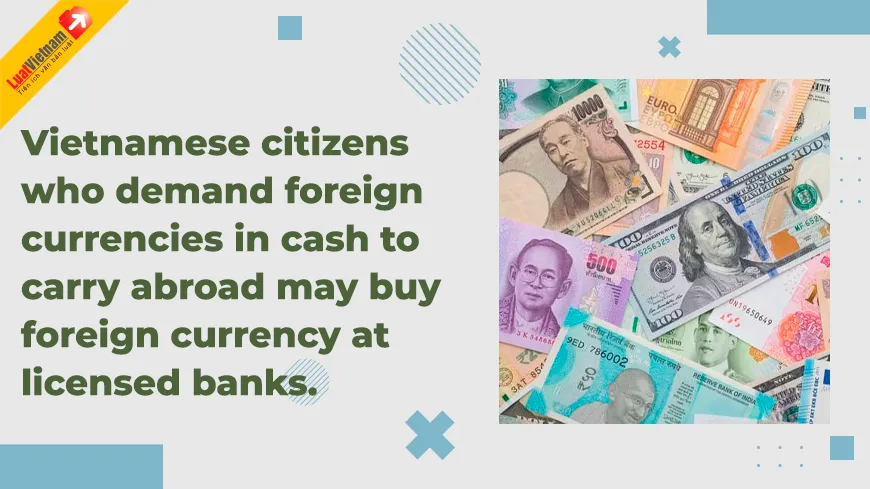
Residents being Vietnamese citizens who demand foreign currencies in cash to carry abroad for the purposes of study, medical treatment, work, tourism or visit may buy foreign currency being the currency of the country where Vietnamese citizens visit at licensed banks.
In cases where such a country has no currency, the licensed banks may sell other freely convertible foreign currencies.
The Circular 20/2022/TT-NHNN takes effect on February 15, 2023.
On December 30, 2022, the Ministry of Information and Communications issues Circular No. 25/2022/TT-BTTTT stipulating the determination of imported raw materials, supplies, and components exempted from import duty, directly serving the production of information technology products, digital content, and software.
Accordingly, raw materials, supplies, and components will be exempted from import duty for the production of information technology products, digital content, and software if being raw materials, supplies, and components imported directly for the production of products on the List of software, hardware and electronic products specified in Circular No. 09/2013/TT-BTTTT promulgating the list of software, hardware and electronic products and Circular No. 20/2021/TT-BTTTT; or promulgating the list of products in accordance with provisions of the Ministry of Information and Communications.
Besides, not being in the list of domestically available machinery, equipment, raw materials, supplies and components for the telecommunications-information technology industry, digital content and software as specified in Appendix 8 to Circular No. 05/2021/TT-BKHDT.
Duty exemption dossiers and procedures must comply with the Government’s Decree No. 134/2016/ND-CP.
This Circular takes effect on February 15, 2023.

On December 26, 2022, the State Bank of Vietnam issues Circular No. 18/2022/TT-NHNN on amending and supplementing Circular No. 09/2015 prescribing debt purchase and sale by credit institutions and foreign bank branches.
Accordingly, the on-balance sheet book value of the purchased, sold debt includes the book value of outstanding principal and interest of the debt and other financial obligations related to the debt (if any) being accounted for on-balance sheet at the time of debt purchase, sale.
On the other hand, credit institutions are not required to have a non-performing loan ratio under 3% when purchasing debts in the following cases:
The credit institution under special control purchases qualified debts as prescribed in Clause 2, Article 146a of the Law on Credit Institutions;
The commercial bank subject to the compulsory transfer for purchase of qualified debts from the credit institution takes the compulsory transfer according to the compulsory transfer plan approved by the competent authority....
Besides, credit institutions and foreign bank branches that are considered and approved by the State Bank for debt purchase must have a non-performing loan ratio under 3% according to the latest classification period pursuant to the State Bank's regulations on property classification, level of deduction, method of setting up risk provisions and use of provisions to deal with risks in the operation of credit institutions, foreign bank branches before the time of requesting for debt purchase’s approval, except for credit institutions under special control.
This Circular takes effect on September 09, 2023.